Real Madrid’s Journey in LaLiga History
In the world of sports, some teams play the game, and others seem to exist on a different plane entirely. Real Madrid, the iconic club known for its brilliant white uniforms, belongs to that second group. But what makes this Spanish team—one of the most famous names in sports—more than just another successful club? What truly makes them football royalty?
The answer starts with their name. “Real” is the Spanish word for “Royal,” a title officially granted to the club in 1920 by Spain’s King Alfonso XIII. This royal seal wasn’t just for show; it was an early sign of the national and cultural importance the team already held. From that moment, they were not just Madrid Football Club, but the Royal Madrid Football Club.
What is LaLiga, and Why Is It Real Madrid’s Proving Ground?
Every major sport has a main stage where its teams battle for domestic supremacy. For American football, it’s the NFL; for basketball, the NBA. In Spain, that stage is LaLiga. This is the country’s top professional football league, and it’s the primary competition where Real Madrid competes from August to May each year, forming the backbone of their entire season.
The way a LaLiga champion is decided is very different from a typical American playoff system. Instead of knockout rounds, the league is a true marathon. Every club plays every other club twice—once at home and once away. The team that accumulates the most points over the 38-game season is crowned champion. There’s no single “Super Bowl” moment; it’s a test of relentless, season-long consistency.
Winning this title is therefore a testament to a team’s endurance and quality. It proves they were the best not just in a handful of high-stakes games, but across an entire nine-month campaign. For a club with the global stature of Real Madrid, consistent dominance in their home league is the bedrock of their reputation. So, just how many times have they conquered this ultimate proving ground?
How Many LaLiga Titles Has Real Madrid Won?
Real Madrid holds the record for the most LaLiga championships in history, with an astonishing 36 titles. This unmatched success in their domestic league is a core part of their identity and the primary benchmark by which their seasons are measured. Winning the league is not just an ambition; for a club of this stature, it is an expectation.
One season in particular showcases what this dominance looks like at its peak. During the 2011-2012 campaign, under manager José Mourinho, the team achieved something legendary. They became the first club in Spanish history to accumulate 100 points in a single season, a testament to their relentless consistency. Along the way, they also shattered the record for goals scored, finding the back of the net a staggering 121 times.
This history of consistent excellence is the foundation of Real Madrid’s global reputation. Winning the domestic league isn’t just about adding another trophy to an already overflowing cabinet; it’s about earning yearly bragging rights in Spain. And for Real Madrid, no bragging rights are more important than the ones they hold over their eternal rivals, FC Barcelona, a conflict that transforms a simple league match into a global spectacle.
El Clásico: Why Real Madrid vs. Barcelona Is More Than Just a Game
That global spectacle has a name: El Clásico. Translating to “The Classic,” this is the term for any match between Real Madrid and their arch-rival, FC Barcelona. On the surface, it’s a battle between Spain’s two most decorated clubs, a head-to-head contest for LaLiga dominance. But the true weight of this rivalry lies far beyond the pitch.
To understand its intensity, you have to look at Spanish history. For much of the 20th century, Real Madrid was seen as the symbol of the centralized Spanish government based in the capital. In contrast, FC Barcelona became a powerful emblem for the unique culture and identity of Catalonia, a proud region with its own language and traditions. For decades, the football field was one of the few places where these competing visions of Spain could clash openly, making every match a proxy for a much deeper cultural and political struggle.
Nowhere was this tension more visible than in the spring of 2011, when the two sides met four times in just 18 days. These fiery matches, featuring legendary duels between superstars like Cristiano Ronaldo and Lionel Messi, became an unforgettable global saga of tactical genius and raw emotion. The rivalry pushes both clubs to their absolute limits, forcing them to constantly seek an edge—often by signing the biggest names in the sport.

What Was the “Galácticos” Era? Building a Team of Superstars
This constant pressure to be the best gave rise to one of the most ambitious strategies in sports history. In the early 2000s, Real Madrid embarked on a policy nicknamed Galácticos, Spanish for “superstars.” The idea was simple and audacious: sign one of the world’s most famous football players every single summer, no matter the cost. It was like a Hollywood studio deciding to produce a blockbuster with only A-list actors, aiming for a spectacle that was impossible to ignore.
This approach brought a staggering collection of talent to Madrid. Global icons like France’s Zinedine Zidane, Brazil’s Ronaldo Nazário, and—perhaps most famously—England’s David Beckham all arrived in successive years. The goal was twofold. On the pitch, this dream team was expected to dominate every competition. Off the pitch, the plan was a marketing masterstroke. Each superstar brought millions of new fans and massive commercial revenue, transforming Real Madrid into a worldwide entertainment brand.
While the original Galácticos era eventually ended, its philosophy became part of Real Madrid’s DNA. It cemented the club’s image as the ultimate destination for football’s elite, a place where the biggest names come to win the biggest trophies. This expectation of star power continues to define the club, creating immense pressure for the modern generation of players who now wear the famous white shirt.
Who Are the Modern Stars Leading Real Madrid Today?
The tradition of signing superstars continues, but the modern Real Madrid looks for more than just a big name. The prime example is the team’s current headliner, English midfielder Jude Bellingham. While midfielders typically support the attack, Bellingham exploded onto the scene as a phenomenal goal-scorer, showing a new kind of superstar—one who redefines his position on the pitch and delivers jaw-dropping performances in LaLiga.
But Bellingham isn’t alone. He’s part of a dynamic young core that includes the electrifying Brazilian winger Vinícius Júnior. A winger is a player who uses speed and skill along the sides of the field, and Vinícius is a master of it. This youthful firepower is balanced by legendary veterans like Croatian midfielder Luka Modrić, who provides the calm wisdom and control that allows the young stars to shine.
This blend of energetic youth and veteran composure is manager Carlo Ancelotti’s winning formula. The current squad is built around a core of defining players, each bringing a unique quality:
- Jude Bellingham (5): The goal-scoring midfielder.
- Vinícius Júnior (7): The lightning-fast winger.
- Luka Modrić (10): The timeless midfield general.
Together, they create magic on a stage worthy of their talent. But it’s not just the players who make Real Madrid special; it’s also the legendary stadium they call home.
Why Is the Santiago Bernabéu Considered a Football Cathedral?
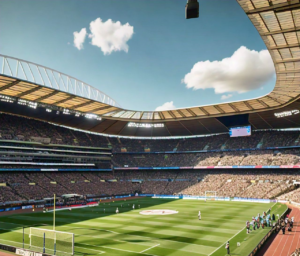
Every legendary team needs a legendary stage, and for Real Madrid, that stage is the Santiago Bernabéu stadium. More than just a home field, the Bernabéu is to football what Madison Square Garden is to basketball or Lambeau Field is to American football—a hallowed ground woven into the fabric of the sport. From the moment you see it, the stadium’s immense scale and stunning modern design signal that this is a place where history is made. It stands as a monument to the club’s ambition and global stature.
For opponents, the Bernabéu is famously a fortress. Its reputation is built on decades of “remontadas” (comebacks), where the roar of over 80,000 fans seems to will the team to victory in the final minutes. The stadium has witnessed every one of the club’s record-breaking European triumphs, making its turf synonymous with glory. To play here is to perform on a stage where giants like Di Stéfano, Zidane, and Cristiano Ronaldo once captivated the world, adding to the immense pressure and prestige.
Recently renovated into a futuristic arena, the Bernabéu experience is now more breathtaking than ever. Whether for a high-stakes Champions League match or an intense Madrid Derby in LaLiga, the atmosphere is electric. The sheer noise and passion create an unforgettable spectacle, turning every home game into a major event. This cathedral of football isn’t just where Real Madrid plays; it’s the source of its power and the heart of its identity.

How to Follow Real Madrid’s LaLiga Journey Today
Following Real Madrid’s journey through the LaLiga season is easier than ever. A simple way to start is by searching for the current LaLiga table to check Real Madrid’s position and points. A spot in the top four indicates they are on track to qualify for the prestigious Champions League, adding context to every league match.
By checking for upcoming fixtures and broadcast information, you can catch the action live. Instead of just reading about past glory, you can watch the living story of Real Madrid unfold each weekend as the club pursues its next trophy.