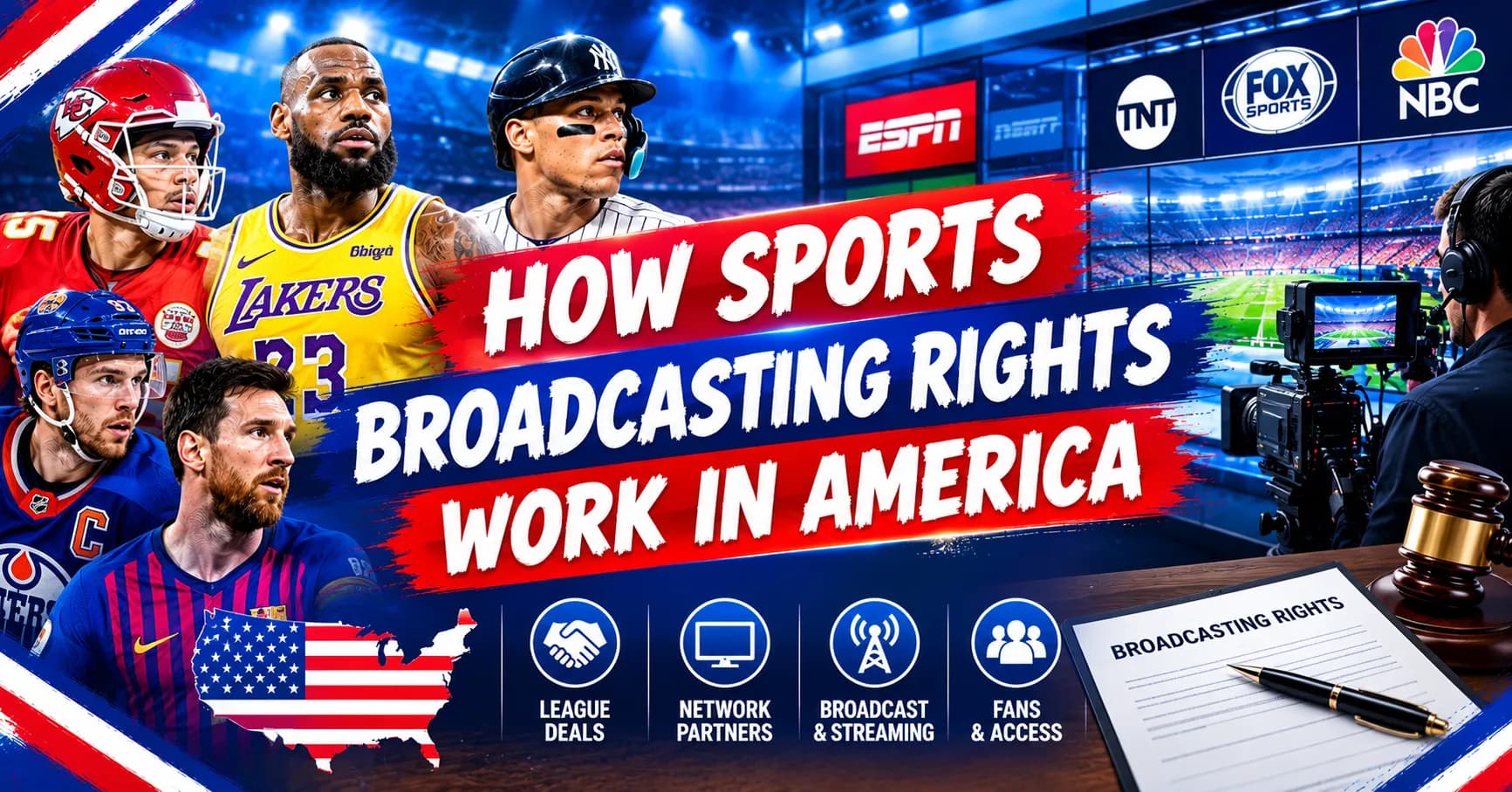
How Sports Broadcasting Rights Work in America
Discover how sports broadcasting rights work in America, from billion-dollar TV deals to streaming platforms. Learn how leagues, networks, and digital services secure exclusive rights, generate revenue, and bring live sports to millions of fans across the country. Stay updated on Sports LNV for more updates.
Sports broadcasting rights play a major role in determining how fans watch live games across the United States. From NFL Sunday afternoon matchups to NBA playoff games and major college football events, leagues sell permission to broadcast their competitions to television networks and streaming platforms. Understanding Sports Broadcasting helps explain why certain games appear on CBS, FOX, NBC, ESPN, Amazon Prime Video, Peacock, or other services, and why viewers sometimes need multiple subscriptions to follow their favorite teams.
In simple terms, sports broadcasting rights are agreements that give a media company permission to show specific sporting events through approved channels or digital platforms. Sports leagues use these deals to generate revenue, expand their audiences, and fund their competitions, while broadcasters use live sports to attract viewers, subscribers, and advertisers.
What Are Sports Broadcasting Rights?
Sports broadcasting rights are legal and commercial permissions granted by a league, team, tournament organizer, or other rights holder to distribute live games, highlights, replays, interviews, and related programming. These rights can be sold to television networks, cable channels, streaming services, radio stations, or digital media companies.
A broadcasting agreement defines what a media company can show, where it can distribute the content, how long the agreement lasts, and whether other companies can show the same event.
For example, a league might grant one network the right to broadcast selected regular-season games nationally while allowing local broadcasters to show other games within specific geographic markets. A streaming service may receive exclusive rights to a particular weekly game or a package of playoff contests.
What Do Broadcasting Rights Usually Cover?
- Live game rights: Permission to televise or stream games as they happen.
- National rights: Permission to distribute selected events across the country.
- Local and regional rights: Permission to show games within designated markets.
- Streaming rights: Permission to distribute events through apps and online platforms.
- Highlight rights: Permission to show selected clips, recaps, and game highlights.
- Replay rights: Permission to provide full-game replays or condensed versions.
- International rights: Permission to distribute events in specific countries or territories.
- Audio rights: Permission to provide radio commentary or digital audio coverage.
These rights may be bundled together or sold separately. A company that owns live television rights does not automatically receive every digital, international, highlight, or audio right associated with an event.
How Sports Broadcasting Rights Work in America
The process generally begins when a league or rights holder decides how to distribute its games and negotiate agreements with media companies. Those agreements establish the events available to each broadcaster, the length of the contract, the distribution platforms, and the financial terms.
- The league controls or organizes the rights. A professional league, college conference, tournament organizer, or individual rights holder determines which media rights it can license.
- Broadcasters negotiate agreements. Television networks and streaming services compete for packages of games, championship events, or exclusive programming.
- Rights are divided into packages. Contracts may separate regular-season games, playoffs, championship events, local broadcasts, and streaming-exclusive contests.
- Broadcasters pay for access. Depending on the agreement, payment may include fixed rights fees, revenue-sharing arrangements, or other commercial terms.
- Games are distributed to viewers. The winning media companies show events through broadcast television, cable, subscription streaming, or other authorized platforms.
- Contracts are monitored and renewed. Leagues and broadcasters evaluate audience reach, commercial performance, and future distribution opportunities when agreements approach expiration.
The result is a media system in which different companies can hold rights to different games from the same league. This is why fans should check the official schedule and broadcaster listings before assuming that every matchup will be available on a single service.
Who Owns Sports Broadcasting Rights?
Ownership and control of sports media rights depend on the sport, competition, and governing agreements. In many professional leagues, the league negotiates national packages centrally, while teams may have separate arrangements for certain local or regional broadcasts. College sports can involve conferences, universities, and governing organizations, depending on the competition and contract.
Rights holders may include:
- Professional leagues: Organizations such as the NFL, NBA, MLB, and NHL.
- Teams: Clubs that control or participate in local media arrangements.
- College conferences: Organizations that negotiate media packages for member schools and competitions.
- Tournament organizers: Entities responsible for events such as championships and international competitions.
- Governing bodies: Organizations that manage particular sports or events.
Once rights are licensed, broadcasters must follow the terms of their contracts. They cannot assume that purchasing one package automatically permits them to distribute every event, clip, or replay across every platform.
How Much Do Sports Broadcasting Rights Cost?
Sports broadcasting rights can cost millions or billions of dollars, depending on the sport, audience size, number of games, exclusivity, contract duration, and commercial potential. Major professional leagues command substantial fees because live sports attract large audiences and create valuable advertising and subscription opportunities.
There is no single price for sports rights. A package covering a handful of regional games is commercially different from a long-term agreement covering national regular-season games, playoffs, and championship events.
What Determines the Value of Sports Rights?
- Audience size: Events that consistently attract large audiences can command higher fees.
- Live viewing demand: Sports are time-sensitive, making live broadcasts valuable to advertisers and platforms.
- Advertising potential: Networks can sell commercial placements during games and related programming.
- Subscription growth: Streaming services may pay for rights to attract and retain subscribers.
- Exclusivity: Exclusive access to high-demand games can make a package more attractive.
- Number of events: Larger packages may include regular-season games, playoffs, and special events.
- Contract length: Long-term agreements can provide financial stability while locking in distribution arrangements.
- Competition among bidders: Multiple interested media companies can increase the price of desirable packages.
Broadcasters try to recover these costs through advertising, subscriptions, distribution agreements, sponsorships, and other revenue streams. The financial outcome depends on the audience attracted and the commercial value generated over the contract period.
How NFL Broadcasting Rights Work
The National Football League uses a combination of national television agreements, streaming partnerships, and special-event arrangements to distribute games. Its media ecosystem includes major broadcast networks, cable channels, and digital platforms. Under the NFL's long-term agreements announced for the 2023 season onward, major partners include CBS, FOX, NBC, ESPN/ABC, and Amazon, with additional streaming arrangements for selected events.
Different partners receive different game packages. For example, CBS and FOX carry Sunday afternoon games in their respective coverage arrangements, NBC presents Sunday Night Football, ESPN/ABC carries Monday Night Football, and Amazon Prime Video is a major home for Thursday Night Football. Other games and events may be available through additional services depending on the season and the specific agreement.
Why NFL Games Appear on Different Channels
The NFL divides its media rights so that broadcasters can offer different parts of the schedule. National prime-time games, Sunday afternoon matchups, international games, playoff contests, and special holiday games may have different distribution arrangements.
Local-market rules also matter. A game shown on a local broadcast station in one city may not be the same game shown in another city during the same time slot. Streaming availability can depend on the package, location, device, and whether a game is nationally or locally distributed.
Fans following team news, salaries, and roster developments can also explore the NFL Contract Tracker 2026 for coverage of reported contracts, salaries, bonuses, and major deals.
How NBA Broadcasting Rights Work
The NBA distributes its games through national television and streaming partners, along with local arrangements where applicable. Its 11-year media agreements with Disney, NBCUniversal, and Amazon began with the 2025–26 season and are scheduled to run through the 2035–36 season.
Under the announced agreement, ABC and ESPN carry a major package of regular-season and playoff games, NBC and Peacock distribute another package, and Amazon Prime Video streams selected regular-season games and postseason events. The allocation varies by event and season, so viewers should check the current NBA schedule for the correct platform.
These agreements illustrate how a league can distribute its content across traditional television and streaming services rather than relying on a single national broadcaster. The NBA can reach viewers through broadcast television, cable, and subscription streaming, while media partners receive defined packages of games and other events.
Why NBA Fans May Need More Than One Service
When national games are split among multiple partners, no single subscription necessarily provides every nationally televised matchup. Local broadcasts may also follow separate arrangements, and availability can depend on the viewer's location and the service's rights.
For that reason, fans should review the current schedule, the streaming platform's coverage details, and any local restrictions before subscribing. A service that offers many NBA games may not include every playoff matchup or every game shown by another partner.
Broadcast Television vs. Cable vs. Streaming Rights
Sports rights can be licensed for different distribution methods. These distinctions affect how viewers access games, how broadcasters earn revenue, and whether a particular event is available without a paid subscription.
| Distribution type | How it works | What viewers should know |
|---|---|---|
| Broadcast television | Games air on local stations affiliated with networks such as ABC, CBS, FOX, or NBC. | Eligible local broadcasts may be available with an antenna, subject to signal coverage and the event's distribution. |
| Cable television | Games air on cable sports networks included in television packages. | Access may depend on a cable or live-TV streaming subscription and the channels it includes. |
| Subscription streaming | Games are distributed through paid streaming apps or services. | Viewers may need a subscription, and some events can have location or package restrictions. |
| Direct-to-consumer services | A league or media company sells access directly through an app or website. | The service may cover only specified games, channels, or events rather than an entire league. |
| Local and regional broadcasts | Games are distributed to viewers within designated markets. | Availability can vary by location, and regional restrictions may apply. |
| Radio and digital audio | Authorized partners provide live commentary or audio coverage. | Audio rights can be separate from television and streaming rights. |
What Is an Exclusive Sports Broadcasting Deal?
An exclusive broadcasting deal gives a media company sole rights to distribute a defined package of sports content within the contract's scope. The agreement may cover a particular game, weekly time slot, tournament, geographic market, or distribution platform.
Exclusivity does not always mean that one company owns every broadcast right for the entire league. A broadcaster could have exclusive rights to one group of games while other networks hold separate rights to other games.
For example, a streaming service might be the exclusive distributor of a designated weekly game, while broadcast networks continue showing other matchups. The contract determines the boundaries of that exclusivity.
Why Sports Broadcasting Rights Are Important to Fans
Media rights affect more than the business relationships between leagues and broadcasters. They directly influence where fans can watch games, how much they may spend, and how easily they can follow a full season.
- Channel availability: Rights agreements determine which network or streaming service carries each event.
- Subscription costs: Fans may need several services if games are distributed across multiple platforms.
- Regional access: Local and regional rules can affect which games are available in a viewer's area.
- Game exclusivity: Certain events may be accessible only through a specific partner or package.
- Replay and highlight access: Contracts determine where official clips, replays, and condensed games can appear.
- International viewing: Rights may differ by country, so a service available in the United States may offer a different package elsewhere.
Understanding these rules helps fans compare their viewing options before paying for subscriptions. It also helps fantasy sports players follow player performances and weekly matchups using legitimate broadcast and streaming sources.
For fantasy football fans, the NFL Fantasy Football Rankings 2026 can help with player comparisons and lineup planning. Learning How NFL Fantasy Football Scoring Works can also help readers understand how real-game statistics translate into fantasy points.
How Broadcasting Rights Affect Advertising and Revenue
Live sports are attractive to advertisers because audiences often watch games as they happen instead of waiting for highlights or on-demand replays. This can make live broadcasts valuable for brands seeking broad reach, event-based campaigns, and highly engaged viewers.
Broadcasters may generate revenue through commercial breaks, sponsorships, promotional integrations, distribution agreements, and paid subscriptions. Streaming platforms may also use sports rights to increase app engagement, attract new customers, and reduce cancellations.
Leagues can use media-rights revenue to support league operations, competition development, marketing, and other business activities. The distribution of money among leagues, teams, players, and other stakeholders depends on the sport's financial and labor agreements.
How College Sports Broadcasting Rights Work
College sports media rights can be more complex because different conferences, universities, and organizers may control or negotiate different packages. Agreements can cover regular-season football, basketball, conference championships, postseason events, and other competitions.
A conference may negotiate a media deal that distributes selected games across broadcast networks, cable channels, and streaming services. Some games may be available nationally, while others appear on conference-specific networks or digital platforms.
The structure varies by conference and contract. Fans should consult the official conference or school schedule to confirm the channel or service carrying a particular game.
What Are Sports Media Rights Packages?
A media-rights package is a defined collection of events and distribution permissions sold under an agreement. Instead of selling every game individually, a league may group events according to audience, time slot, competition stage, or platform.
Common package types include:
- Regular-season packages: Selected games across the main competition schedule.
- Prime-time packages: High-profile events scheduled for prominent viewing windows.
- Playoff packages: Postseason games and championship-round coverage.
- Digital packages: Games or content designated for streaming services and apps.
- Local packages: Games distributed to specific regional audiences.
- Highlight and replay packages: Rights to clips, recaps, and recorded games.
Package design allows leagues to negotiate with several media companies while setting clear boundaries around each partner's rights. It can also make it easier to reach different audiences through multiple distribution channels.
How Sports Broadcasting Rights Differ From Sponsorships
Broadcasting rights and sponsorships are related commercial activities, but they are not the same. Broadcasting rights grant permission to distribute sports content. Sponsorships generally provide a brand with promotional opportunities associated with a team, league, event, or broadcast.
| Feature | Broadcasting rights | Sponsorship |
|---|---|---|
| Main purpose | Authorize the distribution of sports content. | Promote a brand through an association with sports. |
| Typical buyer | Television network, streaming platform, or media company. | Brand, advertiser, or commercial partner. |
| Common benefits | Access to games, broadcasts, and permitted related content. | Brand visibility, promotional placement, and audience engagement. |
| Examples | A network receives rights to air selected league games. | A company sponsors a team, tournament, or broadcast segment. |
A company can hold broadcasting rights and sell advertising around its coverage, but those rights do not automatically grant it every sponsorship or merchandising right connected with the competition.
How to Find Where a Sports Game Is Being Broadcast
The easiest way to find an authorized broadcast is to check the league's official schedule or the official website of the team or tournament. Broadcaster listings can change by event, market, and season, so current information is more reliable than assuming the same channel carries every game.
- Visit the official league or team schedule.
- Find the game date, kickoff time, or tip-off time.
- Check the listed television channel or streaming service.
- Confirm whether the game is nationally televised or subject to local-market restrictions.
- Review the service's subscription and device requirements before watching.
Fantasy basketball players can also consult the NBA Draft Strategy Guide For Beginners for help understanding draft preparation and player selection. Following official schedules alongside player news can make it easier to plan around games and track performances throughout the season.
Frequently Asked Questions About Sports Broadcasting Rights
What are sports broadcasting rights?
Sports broadcasting rights are legal permissions that allow a television network, streaming service, radio station, or other media company to distribute specific sporting events and related content under an agreement.
Who controls sports broadcasting rights in America?
Rights may be controlled or negotiated by professional leagues, teams, college conferences, tournament organizers, or other rights holders. The exact structure depends on the sport and the relevant agreements.
Why are sports broadcasting rights so expensive?
They can be expensive because live sports attract valuable audiences, advertising revenue, and paid subscribers. The cost depends on the popularity of the competition, the number of events, exclusivity, and contract length.
Why are sports games split across different channels?
Leagues often divide media rights into separate packages and sell them to multiple partners. Different networks or streaming platforms may therefore carry different games, time slots, or postseason events.
Can one streaming service show every NFL or NBA game?
Not necessarily. Rights are divided among broadcasters and streaming services, and local-market rules or package restrictions may apply. Fans should check the official schedule and the terms of each service.
What is the difference between national and local sports broadcasting rights?
National rights cover events distributed across the country, while local or regional rights cover games shown within designated geographic markets. The available games can vary depending on the viewer's location.
How long do sports broadcasting contracts last?
Contract lengths vary. Some agreements cover a few seasons, while major professional league deals may extend for a decade or longer. The contract specifies the start date, end date, and any renewal or termination provisions.
Do broadcasting rights include highlights and replays?
Not automatically. Highlights, full-game replays, condensed games, audio, and digital clips may be included in a broader deal or licensed separately. The contract defines what each partner can distribute.
How do broadcasting rights benefit sports leagues?
They provide a major source of revenue and help leagues reach fans through television, streaming, and other media platforms. These agreements can also increase the visibility and commercial value of a competition.
Final Thoughts
Sports broadcasting rights determine how live games reach audiences across America. Through agreements with television networks, cable channels, and streaming platforms, leagues distribute their events while generating revenue from media partnerships. The NFL and NBA demonstrate how rights can be divided across several partners, making official schedules and broadcaster listings important resources for fans. Understanding the difference between national, local, exclusive, and streaming rights helps viewers make informed decisions about how to follow their favorite sports.
For more sports business explainers, league coverage, fantasy guides, and updates, explore Sports LNV and use the official schedules of your favorite competitions to find authorized ways to watch.
Comments (0)
You must be logged in to comment.
Sign InTeams
30Explore team pages & exclusive profiles
📖 You Might Also Like
How To Watch NBA Games Without Cable in 2026
Read the latest in-depth analysis from our sports experts.
Highest Paid NBA Players
Read the latest in-depth analysis from our sports experts.
NBA Draft Strategy Guide For Beginners
Read the latest in-depth analysis from our sports experts.