
Rugby: Rules, Positions, History & Complete Guide
Discover everything about rugby, including how the sport is played, scoring, positions, rules, physical demands, and why rugby is popular worldwide. A complete beginner-friendly guide for sports fans
Rugby is one of the world's most exciting team sports, combining strength, speed, skill, strategy, and teamwork in a way few other sports can match. From packed stadiums to local clubs, rugby has built a passionate global following across countries such as New Zealand, South Africa, England, Australia, France, Ireland, Wales, Scotland, Argentina, and many more.

For someone watching rugby for the first time, the sport can look complicated. Why do players pass the ball backward? What is a scrum? How does a team score a try? And why does the referee keep stopping the game? Don't worry. Once you understand the basic idea, rugby becomes much easier to follow.
Think of rugby as a battle of territory. Two teams compete to move the ball forward, gain valuable ground, and eventually reach the opposition's scoring area. But unlike many field sports, rugby demands players to attack and defend almost continuously. Every metre matters, every tackle can change momentum, and one smart pass can completely open up a defence.
What Is Rugby?
Rugby is a team sport in which two teams compete to score more points than their opponents. Players carry and kick an oval-shaped ball while attempting to advance toward the opposition's goal area.
One of the most distinctive features of rugby is its passing rule. Players can run forward with the ball, but a hand pass must generally travel sideways or backward. This simple rule creates a fascinating tactical challenge because teammates have to run into space and support the player carrying the ball.
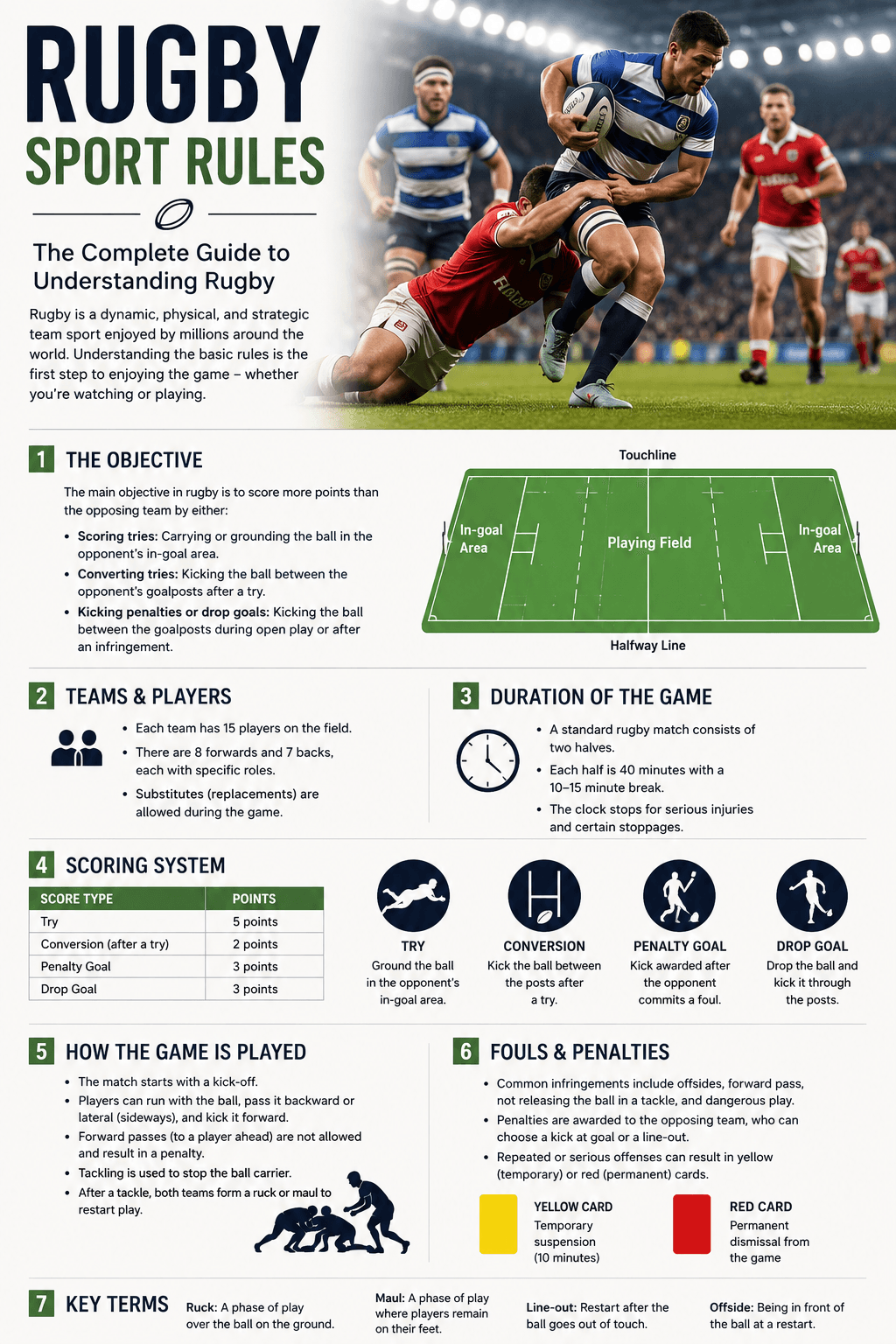
There are several forms of rugby, but rugby union and rugby league are the two best-known versions. Rugby union is traditionally played with 15 players per team, while rugby league normally features 13 players per team. The rules, tactics, scoring systems, and structure differ between the two codes.
Why Is Rugby So Popular?
Rugby has a unique combination of physical competition and tactical intelligence. A match can move from a powerful defensive stand to a lightning-fast attacking play within seconds.
That unpredictability is one reason rugby attracts millions of supporters around the world.
Rugby is also a sport built around teamwork. A single player can produce a brilliant run, but successful teams depend on coordinated movement, communication, passing, tackling, kicking, and support play.
The sport also has a strong international tradition. Major rugby nations compete in tournaments such as the Rugby World Cup, where the world's best teams fight for the Webb Ellis Cup.
How Rugby Is Played
A rugby match begins with two teams competing for possession and territory. Players attempt to move the ball toward the opponent's try line while defending their own scoring area.
In rugby union, a standard team has 15 players on the field. Players have different responsibilities, with forwards generally involved heavily in physical contests and set pieces, while backs often provide speed, creativity, and attacking width.
However, modern rugby is not as simple as saying forwards only attack through strength and backs only rely on speed. Today's game requires almost every player to pass, tackle, run, kick, and make tactical decisions.
Moving the Ball Forward
The ball can be carried forward by a player running with it. Players can also kick the ball forward, creating opportunities to gain territory or put pressure on defenders.
Hand passes, however, must generally move backward or sideways. This means the player with the ball relies heavily on teammates running alongside or behind them.
The Importance of Space
Space is one of the most important concepts in rugby. Attacking players constantly look for gaps in the defensive line, while defenders attempt to close those gaps as quickly as possible.
A perfectly timed pass can turn a small opening into a major attacking opportunity. In that sense, rugby is almost like a moving chess match—except the pieces are running at full speed and tackling each other.
How Teams Score in Rugby
Scoring is one of the first things new rugby fans should understand. In rugby union, teams can score through several different methods.
Try
The try is the most valuable common scoring play. A player scores a try by grounding the ball in the opponent's in-goal area.
Tries are often the most exciting moments in rugby because they usually involve attacking teamwork, powerful running, clever passing, or a perfectly executed kick.
Conversion
After a try, the scoring team receives an opportunity to kick a conversion. The kick is taken from a position aligned with where the try was scored, giving attacking players an additional reward for their successful attack.
Penalty Kick
A team may also score through a penalty kick when the opposition commits certain offences. If the kick goes successfully between the posts and above the crossbar, points are awarded.
Drop Goal
A drop goal occurs when a player drops the ball onto the ground and kicks it immediately after it bounces. It can be a valuable way to score during a close match.
Rugby Positions Explained
Understanding rugby positions makes watching a match much easier. In rugby union, the 15 players are traditionally divided into forwards and backs.
Forwards
The forwards generally take responsibility for many of the game's physical contests. They compete in scrums, lineouts, rucks, and close-range attacking situations.
Forwards are typically associated with strength, ball retention, tackling, and gaining territory. However, modern forwards also need excellent handling and running skills.
Backs
The backs are generally responsible for creating attacking opportunities in wider areas of the field. They often use speed, passing, kicking, and tactical awareness to break defensive lines.
Positions such as scrum-half, fly-half, centre, wing, and fullback all have different responsibilities, but they must work together as one attacking unit.
The Physical Side of Rugby
Physical contact is a major part of rugby. Tackling allows defenders to stop the ball carrier and prevent the attacking team from continuing forward.
But rugby is not simply about being the strongest player on the field. Technique, timing, positioning, fitness, and decision-making are equally important.
A smaller player with excellent footwork can evade a larger defender, while a well-organised defensive line can stop a powerful attacking team without needing individual players to make spectacular tackles.
This combination of physical strength and tactical intelligence is what makes rugby such a fascinating sport to watch.
Rugby Around the World
Rugby has developed into a truly international sport. Nations from Europe, Oceania, Africa, Asia, and the Americas participate in international competitions and work to develop the game at grassroots level.
Countries such as New Zealand, South Africa, England, Australia, France, Ireland, Wales, Scotland, and Argentina have strong rugby traditions and large supporter bases.
The Rugby World Cup provides the biggest international stage, bringing together the best nations and giving emerging rugby countries an opportunity to compete against established powers.
As rugby continues to grow globally, new generations of players and supporters are discovering the sport. Whether you enjoy the tactical battle, the physical contests, the speed of the backs, or the atmosphere created by supporters, there is something in rugby for almost every sports fan.
Comments (0)
You must be logged in to comment.
Sign InTeams
20Explore team pages & exclusive profiles
📖 You Might Also Like

Live Rugby Union Scores: Today's Results, Fixtures & Updates
Read the latest in-depth analysis from our sports experts.

Rugby World Cup 2027: Everything You Need to Know
Read the latest in-depth analysis from our sports experts.
What Is Rugby?
Read the latest in-depth analysis from our sports experts.